Primary school cut-offs moved even more than secondary
How the Reception last distance offered moved at 177 oversubscribed primary schools in England between National Offer Day 2025 and 2026 · Catchmently analysis of council figures · September 2026
If you are choosing a primary school for September 2027, last year's "last distance offered" is an even weaker guide than it is for secondary. At half of the clearly oversubscribed primary schools we looked at, it moved by a quarter or more in a single year.
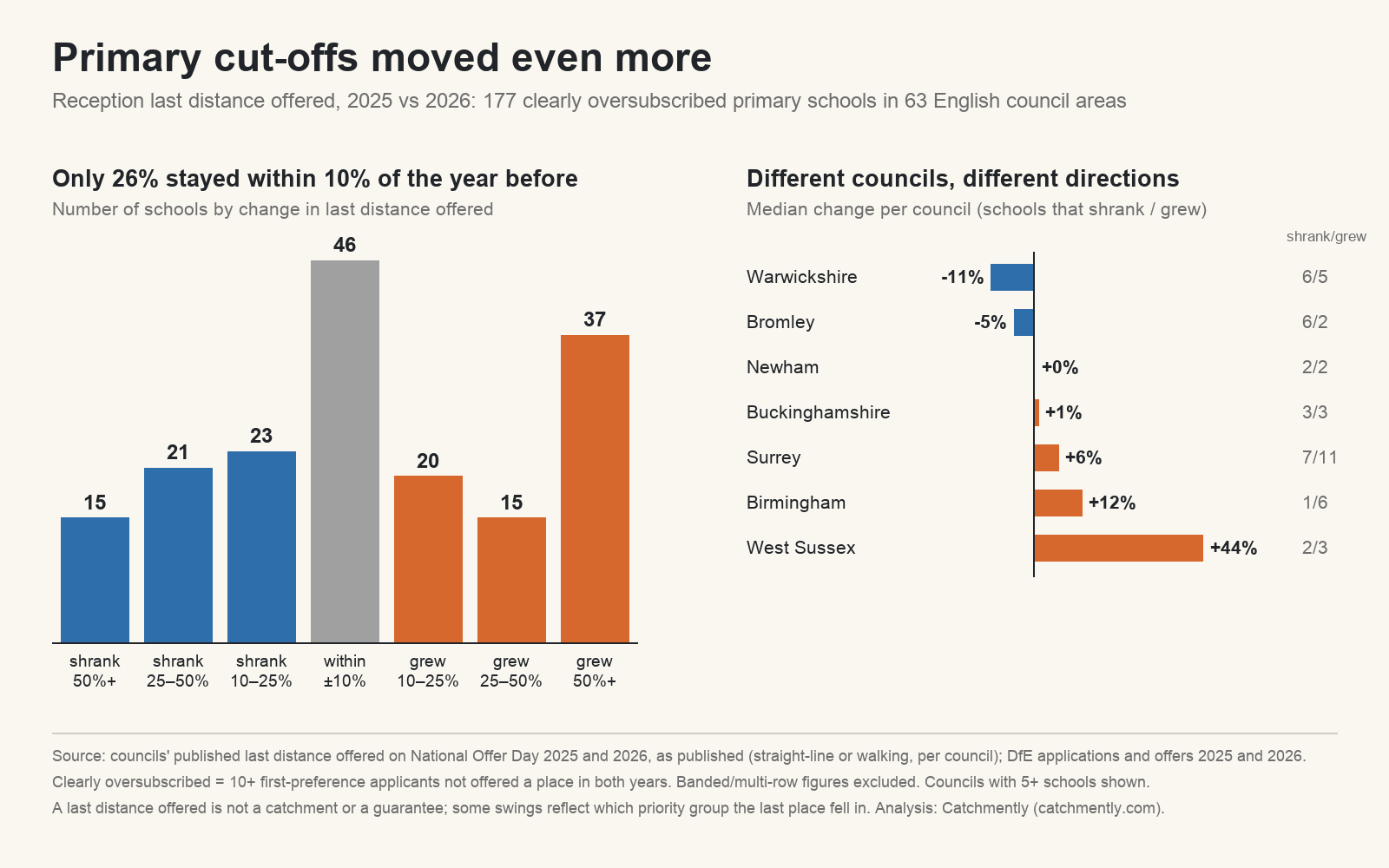
Key findings: Reception, 2025 compared with 2026
We looked at 177 state primary schools in 63 council areas where at least 10 first-preference applicants were not offered a place in both years, and the council published a single last distance offered each year.
- Only 26% had a last distance offered within 10% of the previous year's. 74% moved by 10% or more.
- 50% moved by a quarter or more, and 52 schools by half or more.
- It went both ways: 86 schools' distances shrank and 87 grew.
- The typical move was 25%, about 242 metres. Primary distances are short, so a few hundred metres can be a whole neighbourhood.
- For comparison, only 31% of oversubscribed secondaries stayed within 10% (secondary findings).
By council
Councils with at least 5 schools in the analysis:
| Council | Schools | Shorter | Longer | Median change |
|---|---|---|---|---|
| Warwickshire | 11 | 6 | 5 | −11% |
| Bromley | 8 | 6 | 2 | −5% |
| Newham | 5 | 2 | 2 | +0% |
| Buckinghamshire | 6 | 3 | 3 | +1% |
| Surrey | 18 | 7 | 11 | +6% |
| Birmingham | 7 | 1 | 6 | +12% |
| West Sussex | 5 | 2 | 3 | +44% |
Some examples, as published
- South Farnham School, Surrey: 630 m in 2025, 1,053 m in 2026 (90 places, with siblings taking 41 before distance).
- Wray Common Primary School, Surrey: 1,440 m in 2025, 984 m in 2026.
- Clare House Primary School, Bromley: 0.334 miles in 2025, 0.505 miles in 2026.
- Warren Road Primary School, Bromley: 0.789 miles in 2025, 0.591 miles in 2026.
- Milby Primary School, Warwickshire: 0.337 miles in 2025, 0.63 miles in 2026.
Why primary cut-offs swing so much
Primary schools are small, often one or two classes of 30. A few more siblings, a handful of extra families in a new block of flats or a change in which priority group the last place fell in can move the line by hundreds of metres. Sibling priority matters most: at South Farnham School in 2026, 41 of the 90 places went to siblings before anyone was offered a place on distance.
Five checks before 15 January 2027
- Look at three or more years, not just last year's figure.
- Count the siblings. Ask the school roughly how many siblings are likely in your child's year; they usually come before distance.
- Check how your council measures: straight line or walking route, and from which point of the home and school.
- Use every preference, including a school you are very likely to be offered. Ranking a school lower does not reduce your chance of it.
- Apply by 15 January 2027. Late applications are usually considered only after all on-time ones.
More on this in how to read a last distance offered.
Check the schools near you
Catchmently maps every school in England with its Ofsted report, results and the admissions figures councils publish, each linked to its source. Searching is free. The one-off 3-month pass shows each school's last distance offered year by year.
Method and sources
- Figures: the Reception last distance offered on National Offer Day 2025 and 2026 as published by each council, compared in each council's own unit and way of measuring. Applications and offers from the Department for Education's Primary and secondary school applications and offers.
- Schools included: one published figure per school and year; banded or multi-row figures left out. "Clearly oversubscribed" means at least 10 first-preference applicants were not offered a place in both years.
- Limits: A last distance offered is not a catchment area and does not show any family's chance of a place. Some large swings reflect which priority group the last place fell in, catchment changes or added places rather than demand. Coverage depends on what each council publishes.
- Council sources for the examples: surreycc.gov.uk: FINAL Waverley Primary allocation figures September 2026 V1 · surreycc.gov.uk: FINAL Reigate and Banstead Primary allocation figures September 2026 V · bromley.gov.uk: primary education in bromley 2027 2028 · warwickshire.gov.uk: 2026 reception breakdown of offers. Figures © the publishing councils.
Journalists and researchers: school-level tables are available from support@catchmently.com. You are welcome to use the chart with credit to Catchmently.